Fantasy Football Draft Strategy for 2026: Build a Strong PPR Roster Without Chasing Hype
RedZoneHQ Staff · Sep 2, 2026
Fantasy Football Draft Strategy for 2026: Build a Strong PPR Roster Without Chasing Hype Fantasy football draft season creates a predictable problem every year: managers receive more information than they can realistical…
Fantasy Football Draft Strategy for 2026: Build a Strong PPR Roster Without Chasing Hype
Fantasy football draft season creates a predictable problem every year: managers receive more information than they can realistically process. Training-camp reports, rookie excitement, injury updates, average draft position, rankings, breakout lists and social-media clips all compete for attention. The challenge is not finding opinions. It is building a repeatable process that helps you separate useful information from noise.
For 2026 PPR leagues, the strongest approach is not to memorize one expert's rankings. It is to understand roster construction, opportunity, positional depth, draft cost and uncertainty. A player can be excellent in real football and still be a poor fantasy pick at an inflated price. Another can be less famous but valuable because his role, volume and draft slot create a better risk-adjusted return.
This guide focuses on a flexible 2026 fantasy football draft strategy rather than a rigid list of “must-draft” names. Player values will continue changing through preseason injuries, depth-chart decisions and role changes, so the principles are designed to remain useful until draft day.
Start With League Settings, Not Player Rankings
Before evaluating a single player, understand your scoring and roster format. A ranking built for one league can be misleading in another.
Check:
• Full PPR, half PPR or standard scoring.
• Number of starting wide receivers.
• Number of flex positions.
• Whether the flex includes quarterbacks.
• Passing-touchdown value.
• Tight-end premium scoring.
• Bench size.
• Number of teams.
• Waiver rules.
A three-wide-receiver PPR league increases demand for receivers. Superflex dramatically increases quarterback value. A shallow bench makes replacement players easier to find and can justify taking more upside swings.
What PPR Scoring Changes
Point-per-reception scoring rewards targets and catches in addition to yards and touchdowns. That makes consistent receiving involvement valuable, particularly for running backs and wide receivers who may not be elite touchdown scorers.
A player with eight targets every week can provide a stable floor even when he does not score. A boom-or-bust deep threat may produce bigger individual games but create more week-to-week volatility.
This does not mean receptions are everything. Efficiency, red-zone role and team scoring environment still matter. PPR simply changes the way volume translates into fantasy points.
Use Tiers Instead of a Single Long Ranking
Tiers show where meaningful value gaps exist between groups of players.
A list that ranks Player A 17th and Player B 18th implies a level of precision that may not exist. Tiers group players with similar expected value.
For example:
• Tier 1: Rare volume plus elite efficiency.
• Tier 2: Strong role with one meaningful uncertainty.
• Tier 3: Good starters with comparable projections.
• Tier 4: Upside players with role or durability risk.
When your pick arrives, ask which position is about to lose an important tier. If five comparable receivers remain but only one running back remains in the tier you trust, the running back may be the smarter selection even if your overall ranking places a receiver slightly higher.
Average Draft Position Is a Price, Not a Projection
ADP describes market cost, not a guarantee of future production.
Average draft position, or ADP, tells you when players are being selected. It does not tell you what they will score.
This distinction is essential. If you believe a player should be drafted in Round 5 but his market ADP is Round 8, you may not need to select him in Round 5. You can balance conviction with market information and attempt to capture value.
The reverse is also true. A player can be highly talented but overpriced if the market assumes his best-case outcome.
NFL.com's current 2026 fantasy coverage regularly discusses overvalued and undervalued players relative to draft cost. See NFL Fantasy's 2026 value analysis as one current reference, while remembering that ADP continues to move.
Draft Volume Before You Draft Highlights
Fantasy points are created by opportunity. For running backs, useful opportunity indicators include carries, targets, goal-line work and two-minute offense. For receivers, targets, route participation, red-zone usage and snap share matter.
Highlight clips can show talent, but fantasy managers need to ask whether the player will receive enough chances to use that talent.
Running-back opportunity checklist
• Is he expected to lead early-down carries?
• Will he play on passing downs?
• Does another back control goal-line work?
• How strong is the offensive line?
• Will game script create rushing opportunities?
Receiver opportunity checklist
• Is he a full-time route runner?
• Where does he rank in the team's target hierarchy?
• Does he earn targets in the red zone?
• Does he play inside, outside or both?
• How stable is the quarterback situation?
Quarterback Strategy in One-QB Leagues
Quarterback is the highest-impact position in real football, but fantasy draft value depends on replacement level. In a one-quarterback league, many usable starters may remain available after the early rounds. That can make it rational to wait if the premium options are selected above your preferred price.
Elite rushing quarterbacks can create a special fantasy advantage because rushing yards and touchdowns add production that pure passers cannot always match. However, the correct strategy is still price-dependent.
NFL Fantasy publishes current positional rankings and tiers for the 2026 season, including quarterback analysis. A useful reference is NFL.com's 2026 fantasy quarterback tiers.
Running Back: Chase Role Clarity and Contingent Upside
Fantasy running-back value depends on carries, targets and high-value scoring opportunities.
Running back remains a difficult fantasy position because injuries, committees and game script can change workloads quickly. Instead of treating every backfield as either “bell cow” or “committee,” evaluate how touches are likely to be distributed.
A back who receives 55 percent of snaps but handles nearly every goal-line carry and most targets can be more valuable than a back who plays 70 percent of snaps but loses the highest-value touches.
Late-round running backs
Bench running backs should ideally have a path to a dramatically larger role. A backup who would become the primary starter after one depth-chart change offers more contingent upside than a veteran locked into eight low-value touches every week.
Wide Receiver: Routes and Targets Drive the Position
Route participation and target volume are central to PPR receiver value.
Wide receiver depth is usually strong, but not every receiver has the same route volume. A talented player rotating in for 60 percent of routes may be less useful than a less exciting player who never leaves the field.
Pay attention to:
• Routes per team dropback.
• Target share.
• First-read usage when available.
• Average target depth.
• Red-zone targets.
• Quarterback efficiency.
In PPR formats, short and intermediate targets can create a stable weekly floor. Deep targets provide ceiling but tend to be less predictable.
Tight End: Decide Whether You Want an Advantage or a Stream
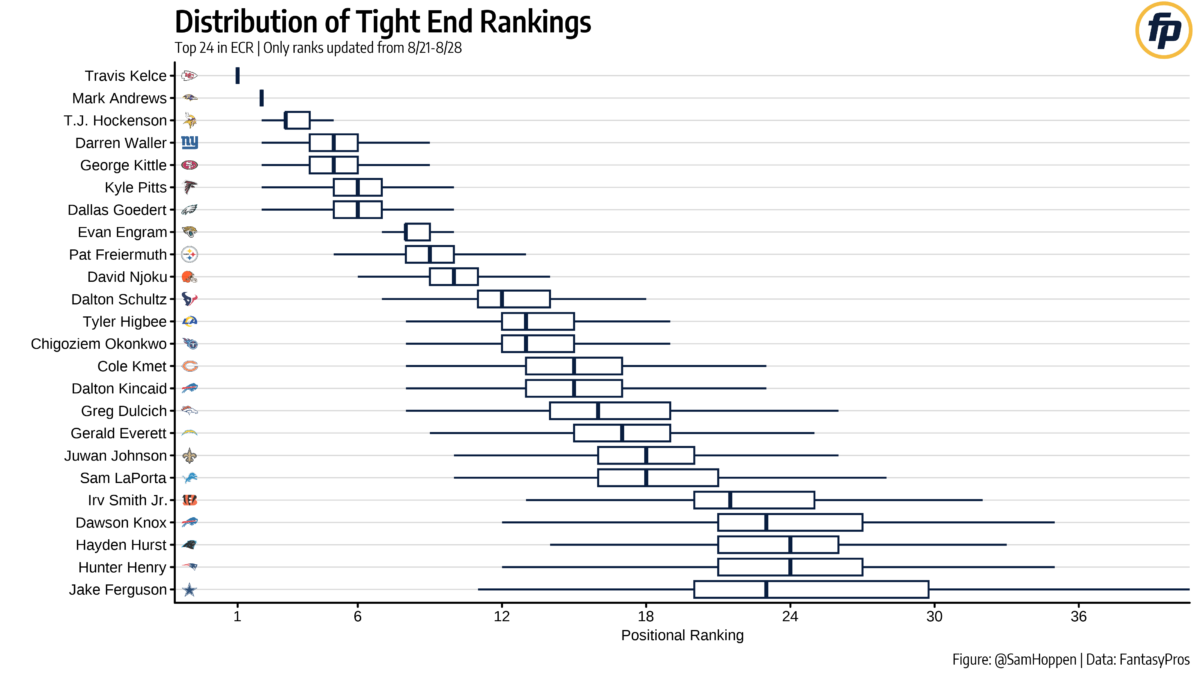
Tight end often divides into a small group of high-volume options and a larger group of touchdown-dependent players. If you draft an elite tight end, you are paying for a potential weekly advantage over the position. If you wait, you should avoid repeatedly spending medium draft capital on players who offer little separation from waiver-wire alternatives.
The broader NFL trend toward multi-tight-end formations may create additional routes and opportunities for some players, but fantasy relevance still depends on targets. Our guide to heavy personnel explains why teams are using more multiple-tight-end groupings in modern offense.
Do Not Overreact to Rookie Status
Rookies create uncertainty in both directions. Some managers avoid them because they have never produced in the NFL. Others aggressively draft them because the upside feels exciting.
A better approach is to evaluate role, competition, draft investment, college skill set and how quickly the position typically translates to the NFL. A rookie running back with immediate goal-line work may be useful quickly. A rookie receiver buried behind established starters may need time.
NFL.com's 2026 rookie projections provide current context for the incoming class, but they should be treated as projections rather than guarantees. See NFL.com's 2026 All-Rookie projections.
Separate Real-Football Quality From Fantasy Value
An excellent blocking tight end can be vital to an NFL offense and nearly irrelevant in fantasy. A quarterback who manages games efficiently can help his team win without producing elite fantasy totals. A slot receiver can generate valuable first downs without scoring enough touchdowns to justify a high draft pick.
Fantasy football rewards specific statistical events. Respecting real football does not require pretending every great player has the same fantasy profile.
Build a Portfolio of Floors and Ceilings
A roster filled entirely with “safe” players can lack league-winning upside. A roster filled entirely with uncertain breakouts can collapse if several roles fail to develop.
A balanced draft often includes:
• Early-round players with secure volume.
• Mid-round players with expanding roles.
• Late-round players who can gain major value if circumstances change.
• A small number of high-variance bets rather than a roster full of them.
Injury Risk: Avoid Pretending You Can Predict Everything
Injuries are part of football, but fantasy managers often overestimate their ability to predict them. A player with a current medical issue deserves scrutiny. A player with a long history of repeated problems may deserve a price adjustment. But labeling every player who has ever missed time as “injury prone” can create false certainty.
Focus on information you can actually use: current participation, documented recovery, expected workload and draft price.
Training-Camp News: What Matters
Not every camp report deserves a rankings change.
High-value reports
• A player is consistently working with the first-team offense.
• A back is receiving passing-down or goal-line reps.
• A receiver's role changes after an injury or trade.
• A rookie clearly moves ahead of a veteran on the depth chart.
• A player is limited by a documented injury.
Low-value reports
• One spectacular catch in a non-contact drill.
• Generic “best shape of his life” comments.
• A coach praising every player in the position room.
• A single practice rep presented without context.
Handcuffing Running Backs: Use It Selectively
Drafting the direct backup to your starting running back can reduce risk, but it also caps roster flexibility. If your starter stays healthy, the backup may occupy a bench spot all season.
Handcuffing makes the most sense when the backup would inherit a clear, valuable role. In uncertain committees, it may be better to draft a different team's high-upside backup and create multiple paths to value.
Draft for September, but Keep November in Mind
You do not need to solve the entire season on draft night. Waivers, trades and role changes will reshape your roster. That means your draft should create a strong foundation while leaving enough flexibility to react.
A bench filled with low-ceiling veterans can make it hard to add emerging players. Early in the season, prioritize bench spots that can gain information value quickly. If a late-round receiver runs nearly every route in Week 1, you have learned something. If he barely plays, you can move on.
A Round-by-Round Framework
This is not a rigid recipe, but it provides a useful decision process.
Draft phase
Primary goal
Avoid
Early rounds
Secure elite volume and stable roles
Paying purely for offseason hype
Middle rounds
Target value, role growth and positional tiers
Reaching far above market without reason
Late rounds
Chase contingent upside and breakout paths
Low-ceiling bench fillers
Final rounds
Defense/kicker if required, last upside shots
Ignoring league settings
Five Questions Before Every Pick
A repeatable decision process helps managers balance role, cost, floor and upside.
1. What role am I buying?
2. What has to happen for this player to beat his draft cost?
3. What is the downside if the role does not grow?
4. Is another position about to lose a major tier?
#5Can I reasonably wait one round based on ADP?
If you can answer those questions, you are making a deliberate decision instead of reacting to a name.
Frequently Asked Questions
Should I draft running backs or receivers first in PPR?
There is no universal answer. Draft the best value within your league settings and positional tiers. PPR increases receiver and pass-catching-back value, but scarcity can make an elite running-back role attractive.
Is zero-RB still viable in 2026?
Any coherent roster-construction strategy can work when draft prices cooperate. The mistake is forcing a strategy when value falls differently than expected.
When should I draft a quarterback?
In one-QB leagues, the answer depends on the gap between elite quarterbacks and the remaining tier. Do not copy superflex draft behavior into a one-QB format.
Should I draft rookies aggressively?
Draft the role and price, not the “rookie” label. Some rookies have immediate opportunity; others need injuries or development before becoming useful.
Conclusion
A strong 2026 fantasy draft is built on process, not prediction theater. You will not correctly forecast every breakout, injury or depth-chart change. You can, however, consistently select players whose roles, prices and upside make sense.
Start with league settings. Think in tiers. Treat ADP as market cost rather than truth. Draft opportunity before highlight reels, and balance stable early-round volume with high-upside bench selections. Most importantly, stay flexible. The best fantasy managers are not the ones who leave the draft believing they won the league in August. They are the ones who build a roster capable of adapting when real football starts providing new information