Complete Guide: How to Use IR Spots Effectively in Fantasy Football
RedZoneHQ Staff · Sep 1, 2026
An in-depth guide on how to use IR spots in fantasy football across different league formats. Learn stash strategy, roster management, and pro tips for maximum impact.
Most fantasy managers struggle with injuries when managing their rosters. Losing one key player for a few weeks can leave you deciding whether to hold an injured player or use that roster spot on someone who can help immediately.
A fantasy football IR spot helps with this exact dilemma.
Roster Management: An IR spot lets you keep an injured player without using a normal active roster position, allowing you to add another player to your team. However, IR spots come with eligibility rules, platform restrictions, and potential roster traps.
Using the IR spot properly can help maintain depth, stash valuable players, and gain extra flexibility during the season. Used carelessly, it can leave your roster unable to make waiver claims or trades.
Here is how to get maximum value out of your IR spots.
What Exactly Is a Fantasy Football IR Spot?
An IR spot is a position reserved for players who meet your platform’s eligibility requirements.
When you move a player to an IR spot, you can keep him on your roster while opening a roster spot for another player. The replacement player could be a waiver pickup, a short-term starter, or a high-upside stash.
The fantasy IR does not necessarily match the NFL’s real-life injured reserve system. Eligibility criteria depend on both fantasy platform and league settings. For example, currently ESPN allows players with an Out or IR designation to occupy an IR slot; suspended players do not qualify. Yahoo, on the other hand, lists several eligible designations, including IR, NFI, OUT, and PUP.
It is important to consider your league’s player card over a news report about a player’s injury.
The Best IR Stash Strategy
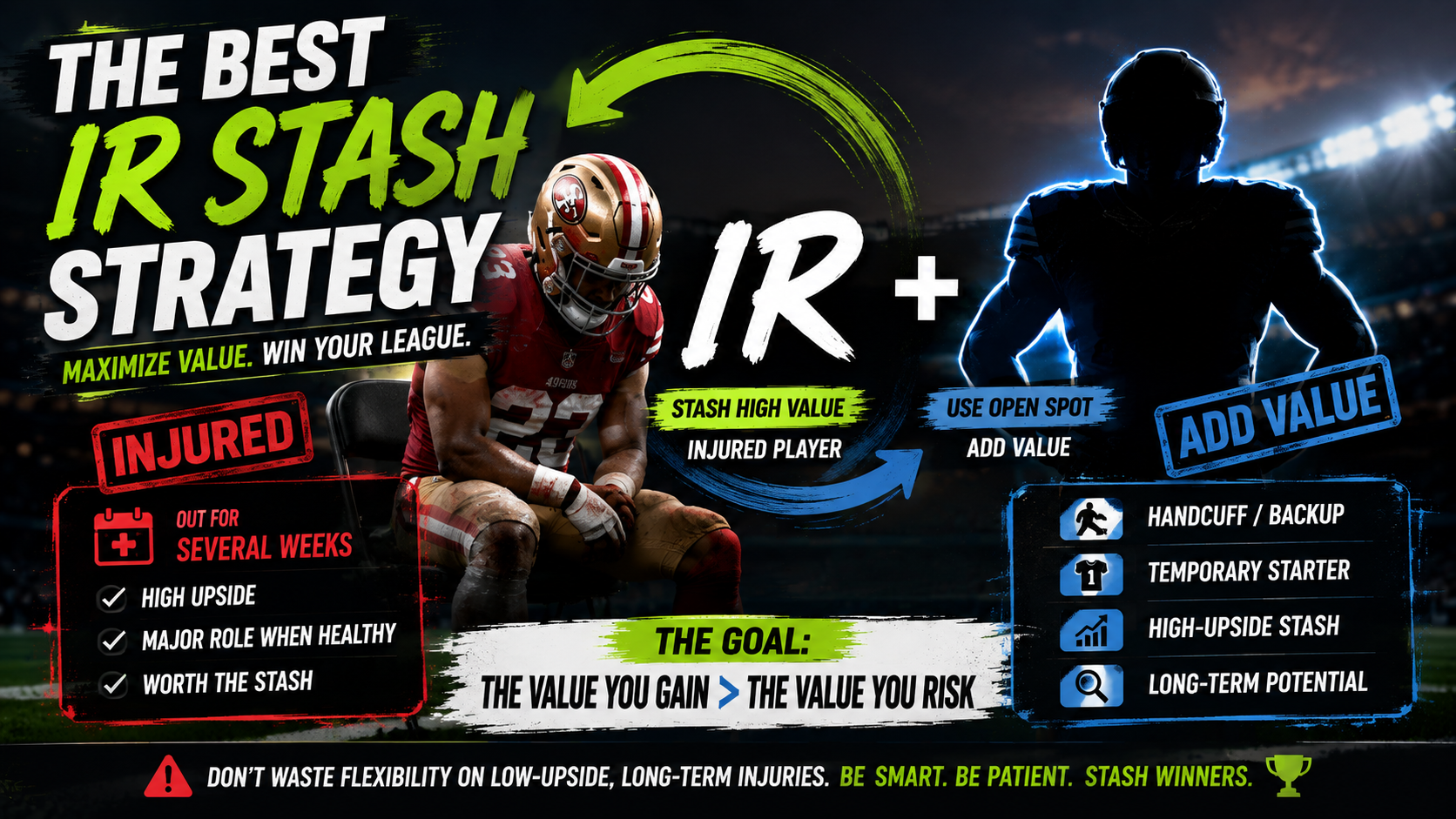
The best IR stash is a player whose expected value after returning is significantly higher than the value of the player you could add from waivers.
This is a two-part decision.
Estimate what the injured player will contribute once he returns
Identify what you can gain by using the newly opened spot
Let’s say you drafted a starting running back who is expected to miss several weeks. If the player is likely to return to a major role, putting him on IR can be an excellent move.
Then you should use the open roster position to add his backup, a temporary starter, or a player with long-term upside.
The same principle is also applicable in reverse. If the injured player has a lengthy recovery and little upside, putting him on IR can waste valuable roster flexibility.
Have a Replacement Player in Mind Before Using IR
One common mistake is moving a player to IR without a plan for the open roster spot.
Here is a better approach. Ask yourself:
Who is available on waivers?
Does the player have a path to becoming a starter?
Is there a rookie gaining workload in training camp?
Does that player have immediate starting value?
This is even more important in shallow leagues.
If your waiver wire has several usable wide receivers, the opportunity cost of holding an injured wideout is higher, and vice versa. When benches are limited, managers view IR as a way to create temporary roster flexibility. Some managers also argue that IR spots compensate teams for losing players to injuries rather than increasing the bench size.
What If You Have Several Injured Players?
If you have multiple injured players at the start of the season, do not use every IR slot on the players with the biggest names.
Ranking them is a smarter move; for each injured player, consider:
Expected return date
Expected role after returning
Fantasy ceiling
Injury uncertainty
Your team’s current record and depth
Quality of your available replacement
A player expected back in two weeks may be more useful than a famous player with a longer recovery timeline.
Your record also influences the decision. A strong team with several healthy starters can wait for an injured player; a team struggling to win early games needs to prefer immediate production.
The Biggest IR Mistake: Set-It-And-Forget-It
An IR spot should not be treated as a set-it-and-forget-it position. Hence, it is important to track an injured player’s status changes. This is especially important before waiver processing.
How to Use IR in Redraft Leagues
In redraft leagues, every missed game reduces your opportunity to score points, making IR spots more valuable.
Prioritize injured players who can still provide meaningful production for the remaining season.
Holding on to a high-level starter who misses a few games is worth it if his projected production after returning is strong.
Be more aggressive with fringe players.
If a player who was already a borderline starter before getting injured misses several games, it can make the roster spot difficult to justify. The waiver wire may offer someone who can help you win immediately.
The same principle applies in PPR and half PPR leagues. The scoring system changes player value, but the basic IR calculation does not change.
How to Use IR In Dynasty and Keeper Leagues
Dynasty leagues have larger rosters, and injured players have value beyond the current season. That’s why IR spots become even more valuable in this format. IR spots help compensate teams for injuries, allowing them to keep valuable players rather than making difficult cuts.
It is smart to think beyond the next few weeks. The following factors come into play for holding an injured player longer than you would in redraft.
Age
Future role
Contract situation
What About Best Ball?
IR strategy becomes less relevant in best ball format, because the format does not require the same weekly lineup management.
It is advised to check the specific contest rules, but the conventional managed league approach of moving an injured player to IR and replacing him on your roster does not translate directly to best ball.
When Should You Drop an Injured Player?
An empty IR spot does not mean every injured player deserves to be held.
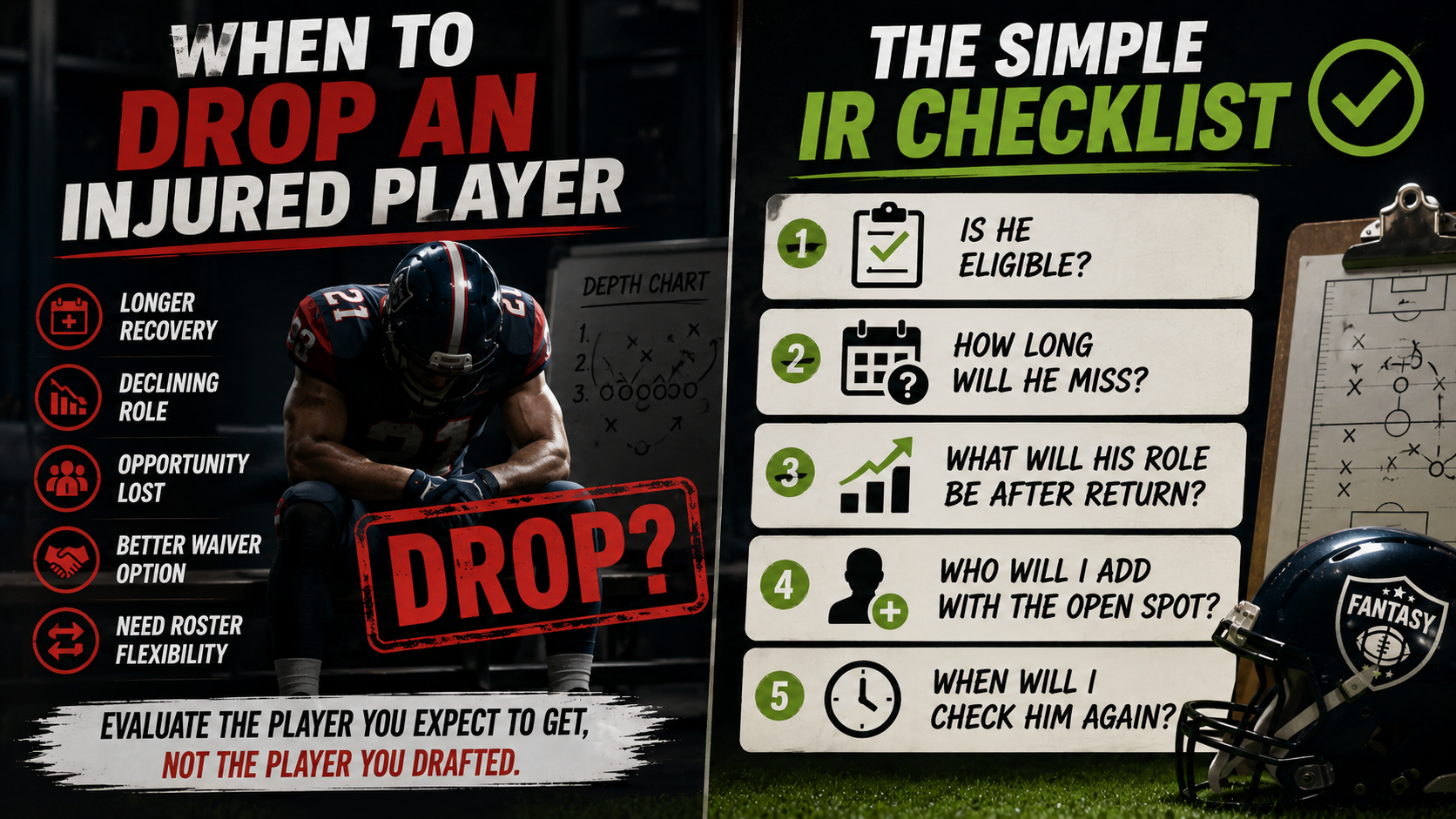
Consider dropping a player when:
Recovery timeline becomes longer
Expected role has declined
A teammate takes over his previous opportunity
The waiver replacement has more short-term value
Your roster needs flexibility for another position
The key is to evaluate the player you expect to get, not the player you drafted.
The Simple IR Checklist
Here are five questions which will help you before placing a player on IR:
1. Is He Actually Eligible?
Check your platform’s eligibility criteria.
2. How Long Will He Miss?
Recognize the difference between a defined absence and an uncertain recovery.
3. What Will His Role Be After His Return?
Check the depth chart and recent team developments.
4. Who Will I Add With the Open Roster Spot?
Have a specific target ready.
5. When Will I Check Him Again?
Monitor the player’s status before waivers and lineup deadlines.
Final Thoughts
A fantasy football IR spot can offer high value when it creates a genuine advantage. Fantasy managers should use it to preserve players who still have meaningful rest-of-season value, and turn the open roster position into something useful.
Track designations, understand your platform’s rules, and reassess injured players as new information arrives. A calculated approach turns the IR spot from a place to park injured players into a real roster management tool.